


 Italiano
why the first weeks are spent looking
Clients ask two questions in the first meeting. One is about cost. The other, asked more carefully, is about time: how long before I see something?
The honest answer is that you will see something quickly, and it will be a sketch. The drawing a builder can price, the drawing that satisfies a planning officer, the drawing that tells you where the light falls in February takes longer, and the reason it takes longer is the whole argument of this piece.
We work on period houses, restaurants and hospitality in London and across Italy. The weeks that look slow at the beginning are the weeks that decide everything after them.
The time goes in before the drawing, not after it.
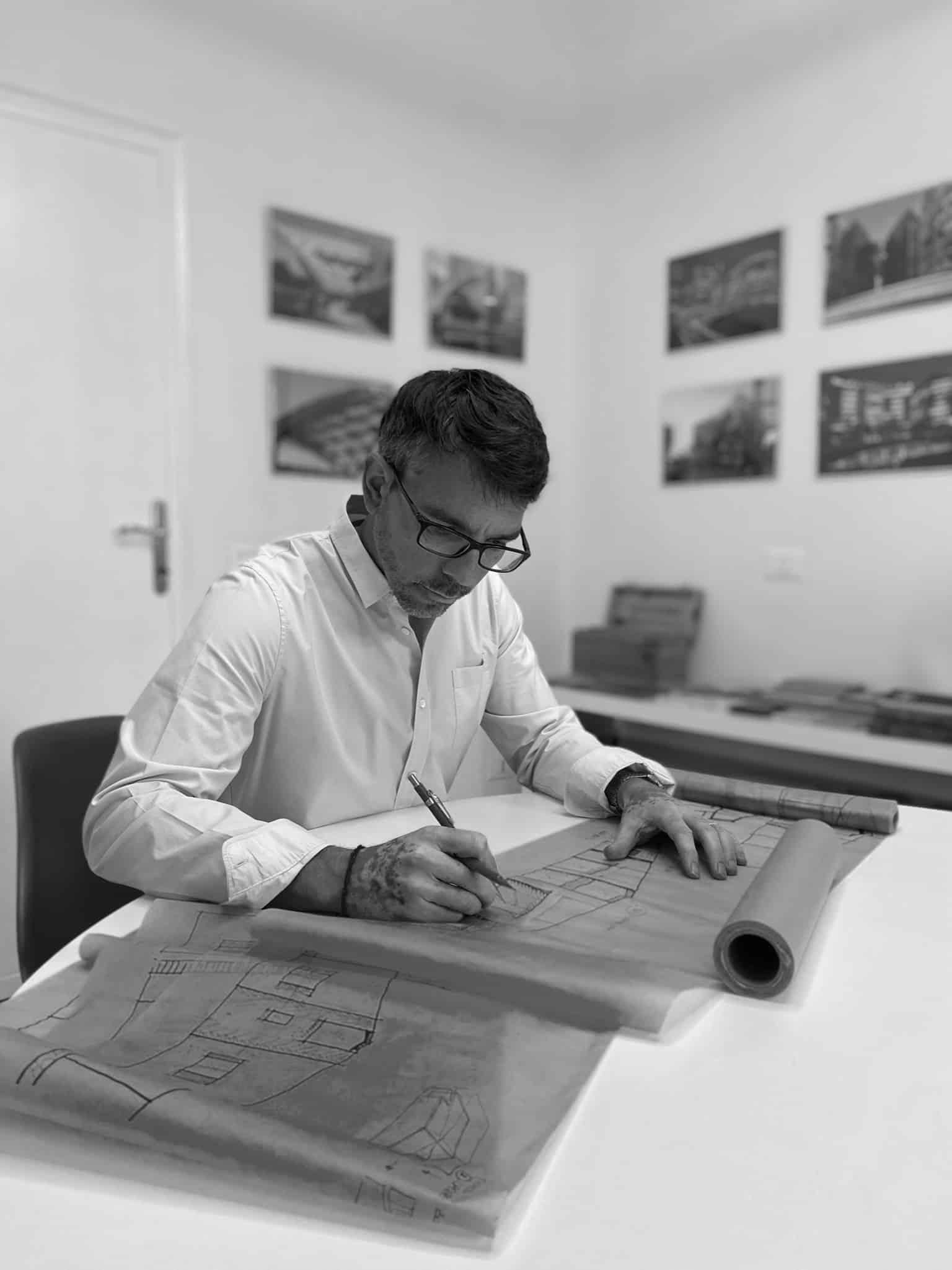
the first thing we do is not design
Robert draws by hand. Not as a stylistic preference and not because the software is difficult, but because a pencil is slower than a mouse and the slowness is the point. A sketch cannot resolve a detail it has not understood. It stalls, and where it stalls is exactly where the problem is.
Before that comes the part that looks like nothing is happening: standing in the building at different times of day, walking the site, finding where the sun arrives in the morning and where it has gone by three, noticing which room the family actually uses and which one they only walk through.
On a period house this is not romanticism. It is the only way to find out how the building was made to work: where the loads go, why the plan is arranged as it is, which walls are original and which are a 1970s idea. None of it produces a drawing. All of it decides what the drawing will be.


what the hand sketch is for
A hand drawing is a way of thinking rather than a way of presenting. It is provisional, and it looks provisional, which is useful: a client can argue with a sketch. Nobody argues with a photorealistic visualisation. They approve it or reject it, and by then the thinking is over.
The sketch also stays at the right level of resolution. It says this room opens this way, the stair moves here, the light comes from above. It does not commit to a door handle. The early decisions are the expensive ones, and they deserve to be made while they are still cheap to change. We move to the computer when the idea is stable enough to be tested rather than found.
where this comes from: slow food, and a practice with two homes
Our practice has one foot in Tuscany and one in London, and the Italian half of that is not a decorative fact.
The argument started with food. In March 1986 a McDonalds opened by the Spanish Steps in Rome; the protest that followed led Carlo Petrini to found the association that became Slow Food, with its international manifesto signed in Paris three years later. The case was never nostalgia. It was that speed had been allowed to define quality, and that the alternative is not going backwards but paying attention to where things come from, who made them, and how long they properly take.
The parallel with building is close enough to be uncomfortable. A house can be delivered quickly by a process optimised for throughput: standard details, a plan lifted from the last job, decisions made before anyone has visited in winter. It will complete. It will also be the house nobody quite loves, and that is paid for over decades.

what the time actually buys
Fewer changes on site. Variations are the most expensive way to design a building. A change that costs a morning at sketch stage costs a week during construction and an argument afterwards.
A plan that fits the way you live. Almost every project we take on could be solved with more square metres. Most are better solved with a better arrangement of the metres already there, and finding that arrangement takes looking, not drawing.
A better case in planning. Conservation officers and committees respond to schemes that demonstrably understand the building and the street. That understanding is visible in the drawings and cannot be manufactured at the end.
A building that ages. Materials chosen for how they will look in fifteen years rather than in the photographs, and details that assume rain.
what we are not saying
Slow is not a virtue in itself. Delay caused by indecision, by a practice carrying too much work, or by drawings that arrive late is not craft. It is just delay, and clients are right to be intolerant of it.
The distinction is where the time goes. Time spent understanding a problem before solving it is an investment with a return. Time spent waiting is a cost.
A good practice should be able to tell you which one you are paying for, at any point in the project. If it cannot, that is the answer.


the fast world, and what it cannot teach
Both of us trained in large practices before setting up on our own. Robert studied at Liverpool, was nominated for the RIBA President Silver Medal and spent years at Foster + Partners, becoming one of the practice youngest Associate Partners.
Elisa studied at Roma Tre, worked at Studio Fuksas , then joined Foster + Partners in London for More London.
Large projects teach precision, coordination and how not to be frightened of complexity. What they cannot teach is the value of the small, slow, particular decision, because at that scale nobody has room to make one. That is the thing we set out to keep.
reflection
So: how long should an architect take? Long enough to have understood your building before drawing it, and not one week longer. The projects that go well are not the ones that started fastest. They are the ones where the first decisions were made with the building in front of us, at the hour of day when its problems are visible.
If you have a building and a question about what it could become, tell us where it is and what you have in mind.